Designing competitions for the 99% who don't win
A Competitions ecosystem for Leep Audio — reframing music contests as a recurring growth engine that rewards every artist, not just the one on top.


INDUSTRY.
Music & Entertainment
Tools.
Figma, Claude
Role.
UI/UX Design
Overview
Leep Audio is an early-stage platform for emerging music artists. It's a place to get discovered, get feedback, and collaborate, deliberately positioned against passive streaming. The founders came to us with a product already in beta: several sections in progress, a small community growing organically on Discord, and a clear sense of what mattered most: Competitions, the least developed area.
Three constraints shaped the work: a fixed five-week timeline, a section that had to scale to multiple simultaneous competitions, and a development handoff through the client's AI-assisted build tool (Lovable) — which meant our designs had to be build-ready with a clean components library.
— direct and indirect competitor analysis.
THE OPPORTUNITY
Most platforms reward one winner and abandon everyone else
To understand the landscape, we audited direct music competition platforms like Splice, SKIO, and LabelRadar, plus adjacent creative-competition platforms like Kaggle and Dribbble. A clear pattern emerged: most platforms handle the mechanics of a contest reasonably well but are built for the winners, and everyone else is left with nothing to come back for. That gap became our opportunity.
That gap reframed the problem for us. If competitions only pay off for the winners, they can't bring artists, producers, and fans back again and again — so the real question became how you make entering worth it for the 99% who don't win? Our answer was a recommendation we brought to the founders directly: a post-competition recap every participant receives, winner or not, turning "you didn't place" into a record of what they gained. It became the Leep Recap, and it anchored everything that followed.
THE PROCESS
From a wide brainstorm to a scalable, trustworthy structure
Feature Prioritization. With that direction set, we moved from why to what. As a team, we brainstormed the full range of features a competition ecosystem could include. From there, I took ownership of prioritization, ranking each feature against user value and build effort, and protecting the ones that serve the majority who don't place first, not just the mechanics that make a contest run.
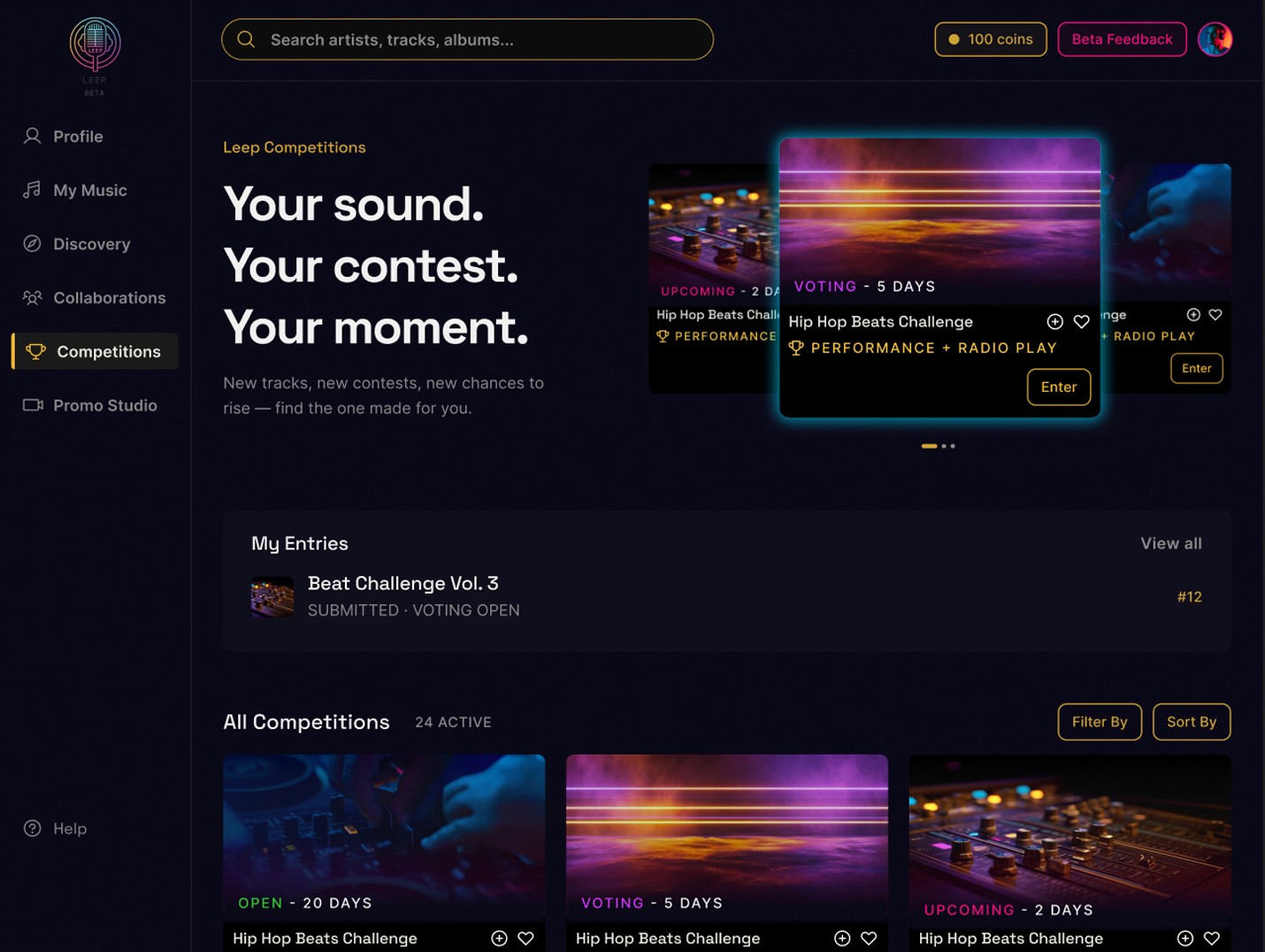
Architecture. With the feature set scoped, we mapped the information architecture for the Competitions section. We also mapped the competition lifecycle as four states — Upcoming → Open → Voting → Closed — recognizing that each state changes what a page needs to do and which action should lead.
Flows and Wireframes. From there we moved into user flows and low-fidelity wireframes, and this is where I took full ownership of the artist participation flow, end to end. I created lo-fi wireframes of the entire user journey, from browsing competitions to submitting an entry to landing on the Competition Recap: the post-competition screen that turns "you didn't win" into "here's how you grew."
— sitemap, user flows, wireframes, and design system.
THE DESIGN CHALLENGE
The detail page was organized logically but it wasn't persuading anyone
This is a part of the project I personally owned. Once the flows were set, we divided responsibilities across the team, and I took the Competition Detail page, the screen a user lands on after selecting a competition, where they decide whether to enter. It's the conversion moment of the entire section.
My first version was structured logically: it led with a how-it -works overview and the prize breakdown. Our research had shown that transparency drives participation; emerging artists won't submit if they don't understand how decisions are made. So leading with the mechanics made sense.
When I presented it, the client's feedback reframed the problem. They wanted the page to work as a hook, to show an artist where they could be if they entered, to feature the artists whose tracks were up for remixing, to lean on the judges for legitimacy, and to make the prizes and exposure immediately visible. In short: sell the opportunity before explaining the process.
So I rebuilt the hierarchy. This page's job in the Open state is to win the commitment, so it now leads with Persuasion content: featured artists, judges, prizes. The aspirational, emotional case for entering. Followed by Reference content: rules, how-it-works, submission mechanics. The functional detail you need after you've decided. I kept the enter CTA in the side rail but towards the top.
I also kept the lifecycle in mind: this reordering is state-dependent. In the Open state the page is converting, so persuasion leads. But in Voting or Closed states the same page does a different job, and the hierarchy shifts accordingly.
The learning: information hierarchy is a persuasion tool, not just an organizational one. The order of information is itself a design strategy.

The recap every participant receives — a key recommendation we brought to the founders, and they adopted.
Final rank
Track listens
New followers
Most replayed moment
Profile Visits
Design System & Components
A clean design system ready for handoff into Lovable: role colors (artist, producer, fan) and the four lifecycle states — Upcoming, Open, Voting, Closed — that drive how every competition screen behaves.
